

Edna Binga, Alyssa Lunman, Sana Shezhad, Maria Fitian, Mishal Razi, Nahal Jangda and Honora LaRock
C.elegans Uterine and Vulval Muscle Cell Development
Abstract:
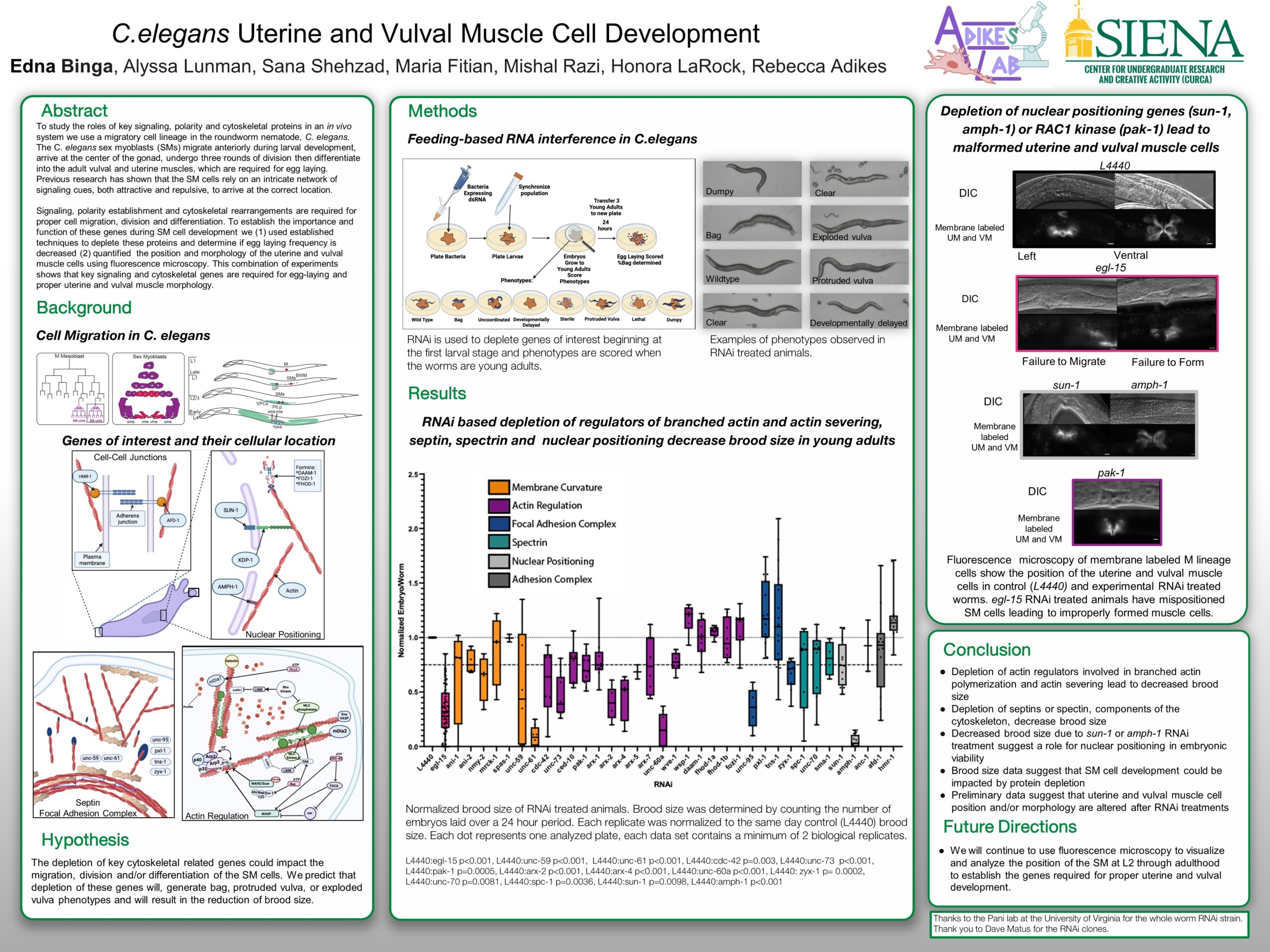
To study the roles of key signaling, polarity and cytoskeletal proteins in an in vivo system we use a migratory cell lineage in the roundworm nematode, C. elegans. The C. elegans sex myoblasts (SMs) migrate anteriorly during larval development, arrive at the center of the gonad, undergo three rounds of division then differentiate into the adult vulval and uterine muscles, which are required for egg laying. Previous research has shown that the SM cells rely on an intricate network of signaling cues, both attractive and repulsive, to arrive at the correct location. Signaling, polarity establishment and cytoskeletal rearrangements are required for proper cell migration, division and differentiation. To establish the importance and function of these genes during SM cell development we (1) used established techniques to deplete these proteins and determine if egg laying frequency is decreased (2) quantified the position and morphology of the uterine and vulval muscle cells using fluorescence microscopy. This combination of experiments shows that key signaling and cytoskeletal genes are required for egg-laying and proper uterine and vulval muscle morphology.Title
C.elegans Uterine and Vulval Muscle Cell Development
Faculty Advisor
Dr. Rebecca Adikes
Location
Table 23