

Charlie Gaffney
Healthy, Equitable & Resilient Albany: Climate Impacts, Social Vulnerability, and Opportunities for Adaptation and Mitigation in the City of Albany
Abstract:
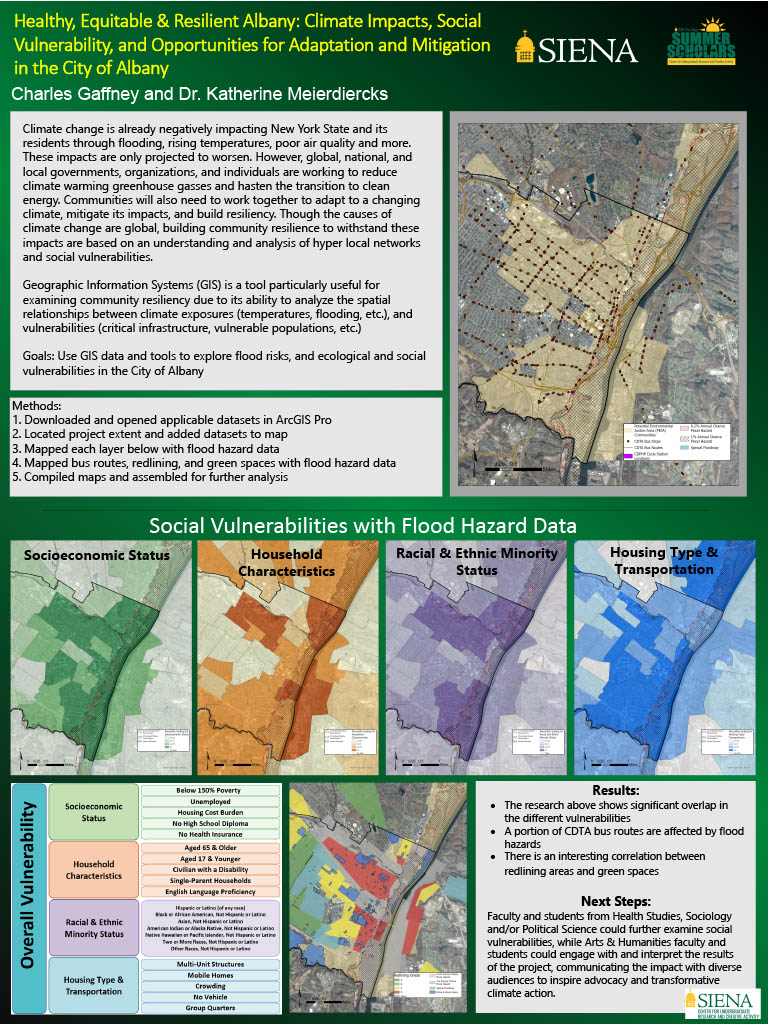
Climate change is already negatively impacting New York State and its residents through flooding, rising temperatures, poor air quality and more. These impacts are only projected to worsen. However, global, national, and local governments, organizations, and individuals are working to reduce climate warming greenhouse gasses and hasten the transition to clean energy. Communities will also need to work together to adapt to a changing climate, mitigate its impacts, and build resiliency. Though the causes of climate change are global, building community resilience to withstand these impacts are based on an understanding and analysis of hyper local networks and social vulnerabilities. Geographic Information Systems (GIS) is a tool particularly useful for examining community resiliency due to its ability to analyze the spatial relationships between climate exposures (temperatures, flooding, etc.), and vulnerabilities (critical infrastructure, vulnerable populations, etc.) Using GIS data and tools I explored flood risks as well ecological and social vulnerabilities in the City of AlbanyTitle
Healthy, Equitable & Resilient Albany: Climate Impacts, Social Vulnerability, and Opportunities for Adaptation and Mitigation in the City of Albany
Faculty Advisor
Dr. Katherine Meierdiercks
Location
Table 1